EV charger installation in Seattle, the Eastside and Everett
A Level 2 EV charger in a Puget Sound home typically runs $900–$2,500 when the panel has spare capacity, and $1,800–$4,500 for a long or trenched run. Washington requires an electrical permit before the work starts, bought by the contractor. HB Power Electric pulls it and schedules the inspection with SDCI, your city or L&I.
- Permitted & inspected
- Owner-run · WA Journey Level (01) + Electrical Administrator
- Licensed and bonded — verify # HBPOWPE758PO ↗ (opens in a new tab)
| Typical range | $900–$2,500 for a Level 2 install on a panel with spare capacity As of September 2026 |
|---|---|
| Long or difficult run | $1,800–$4,500 for a detached garage, trenching, or a 60–100 ft run As of September 2026 |
| Circuit | 60 A breaker for a hardwired 48 A charger; 50 A breaker for a NEMA 14-50 receptacle |
| Permit | Required before work starts. We buy it and meet the inspector. |
| Who issues it | SDCI in Seattle, the city in Bellevue, Everett and Federal Way, Tacoma Power in Tacoma, L&I in Bothell, Kent and Issaquah |
| Home rebates | None. No utility on this corridor offers a residential charger rebate as of 2026-09-05. As of September 2026 |
| Commercial and multifamily | $5,000–$25,000 for 2–6 ports, with utility programs often covering most of it As of September 2026 |
| Licence | WA Electrical Contractor HBPOWPE758PO, General (01), licensed and bonded |
Hardwired 48 A charger or a NEMA 14-50 receptacle?
This is the first decision, and it sets the shape of everything after it.
A hardwired 48 A charger — a Tesla Wall Connector, an Emporia Pro, a DeWalt 48 A — draws 11.5 kW at 240 V. Charging is a continuous load, so the circuit is sized at 125 percent of that: a 60 A breaker and #6 copper. Hardwiring is the only option above 50 A, because a NEMA 14-50 is a 50 A receptacle, and it is the only way to get the full 48 A.
A NEMA 14-50 receptacle sits on a 50 A breaker and caps the car at 40 A continuous, or 9.6 kW. It costs less, most portable units ship with that plug, and you can unplug the charger and take it with you when you move. The catch is that a receptacle feeding a charger needs GFCI protection under NEC 625.54. A GFCI breaker costs more than a plain two-pole breaker and nuisance-trips with some vehicles.
For a car that charges overnight in a garage, the gap between 9.6 kW and 11.5 kW rarely decides anything. The distance from the panel to the parking spot usually does.
Will your panel take the circuit?
Before quoting, we run a load calculation on the existing service under NEC 220.83, the existing-dwelling method that adds the new load to the recorded demand. There are three outcomes.
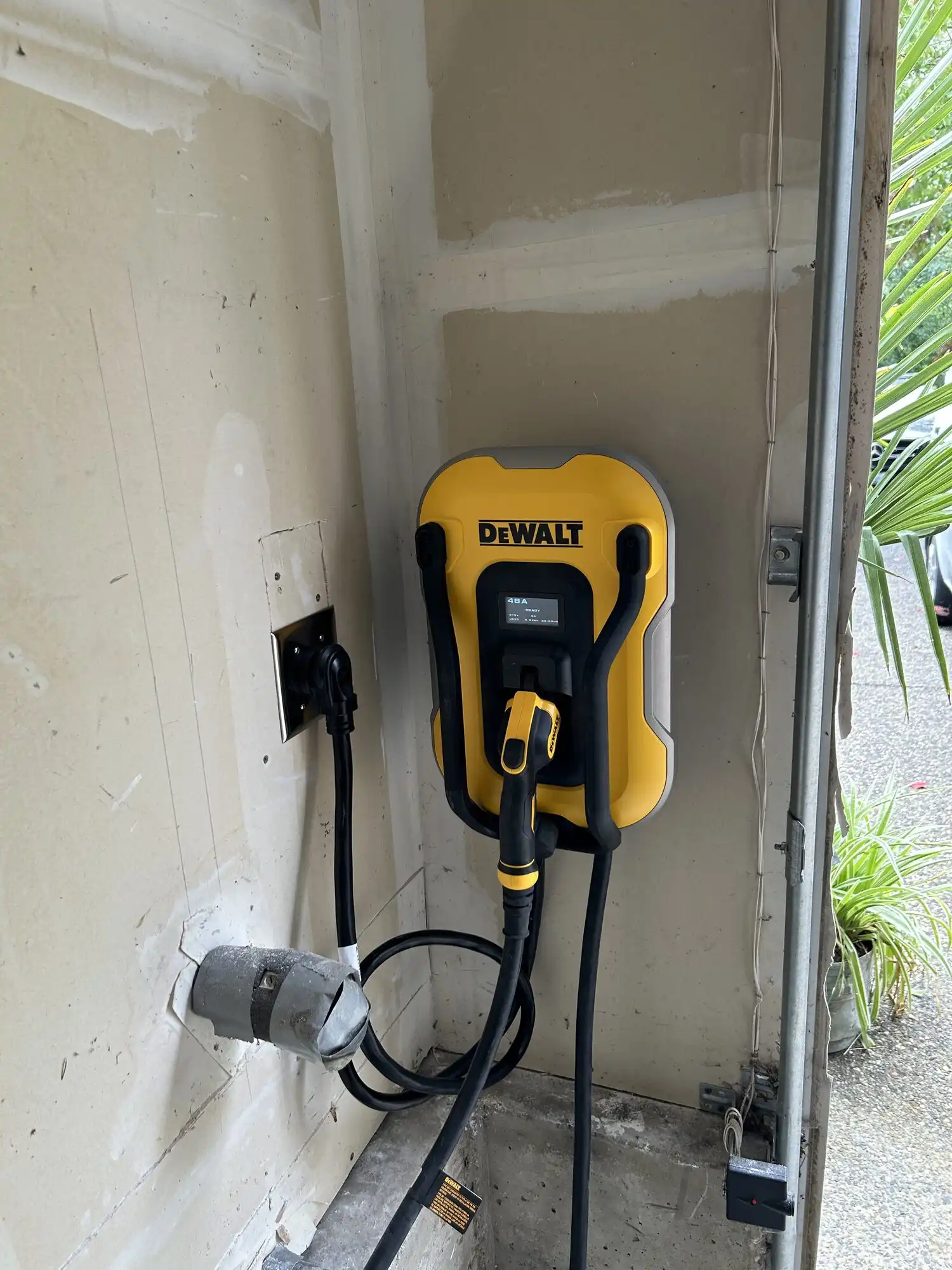
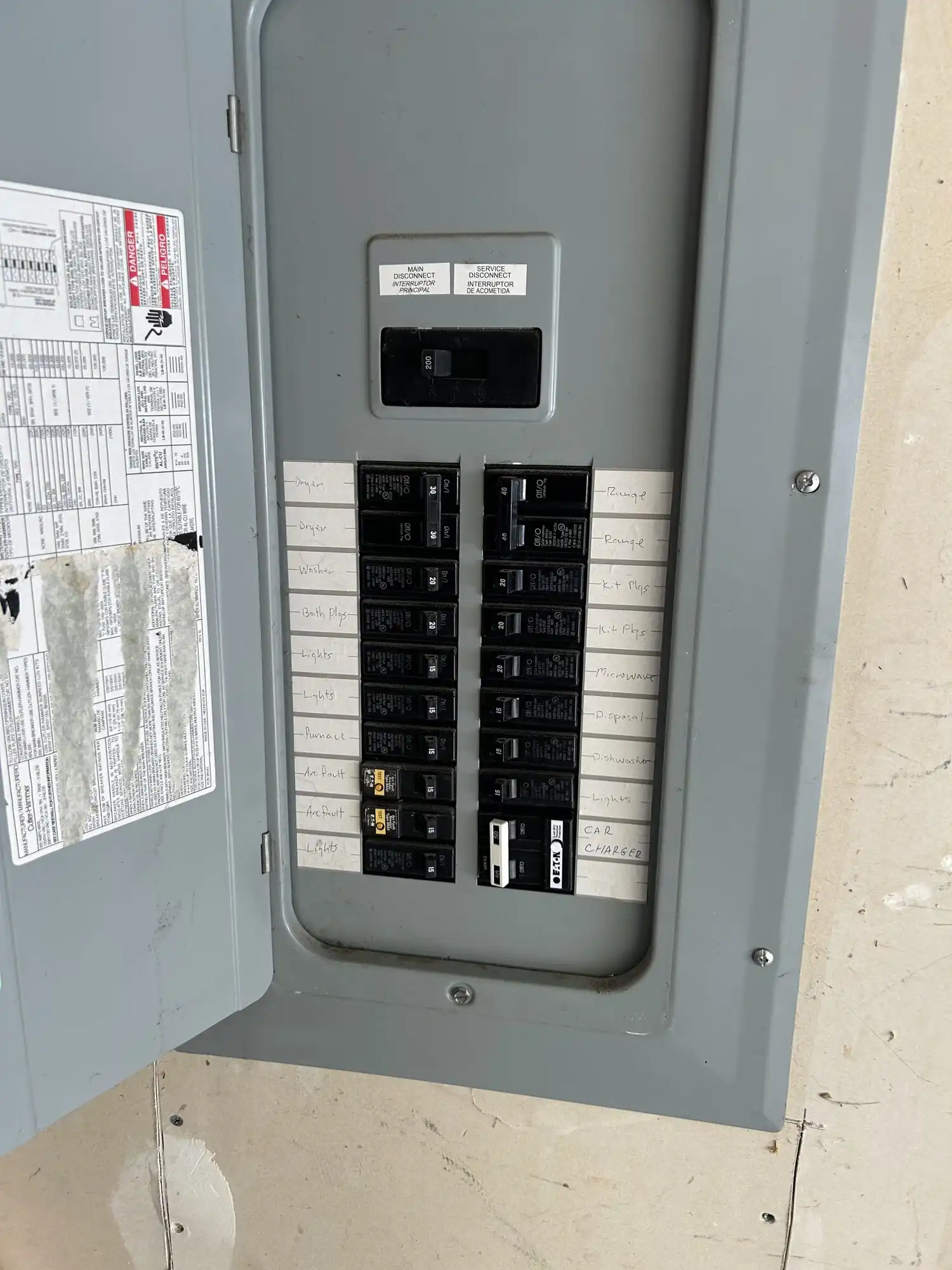
Spare capacity and a spare slot. The Everett job below is the easy version: a 200 A panel with room for a new Eaton two-pole breaker, written onto the paper directory as CAR CHARGER. One circuit, half a day.
Capacity but no slot. Tandem breakers, relocating a circuit, or a small subpanel. That adds a few hundred dollars, not thousands.
No capacity. A 100 A service already carrying an electric range, a dryer and a heat pump often fails the calculation at 48 A. There are three ways out, in order of cost. Set the charger down: nearly every Level 2 unit fixes its maximum current at commissioning, and 32 A still adds far more range overnight than most drivers use in a day. Add a load-management device: an energy management system under NEC 750 watches the service and sheds the charger when the house pulls near the limit, which lets a 100 A service legally carry a charger it could not otherwise. Or upgrade the service, which is a separate project with a utility disconnect to schedule and is covered on the panel upgrade page.
Load management is almost always cheaper than a service upgrade. Ask about it before anyone quotes you a new service.
Who issues the permit, and what the inspector checks
Washington requires an electrical permit before the work starts, and WAC 296-46B-901 puts that obligation on the contractor rather than the homeowner. Which authority issues it is set by the address; the quick facts on this page list it city by city. What changes with the authority is the paperwork and the fee. Where Washington L&I is the authority, the fee schedule effective 2026-07-01 charges $100.50 for the first panel of up to five circuits and $8.20 for each additional circuit. Seattle, Tacoma Power and most incorporated Eastside and Snohomish cities issue their own permits at their own fees.
The inspection itself is short and specific. The inspector checks conductor size against the breaker, terminations and torque, bonding and grounding, GFCI protection where a receptacle is involved, working clearance in front of the panel, a legible circuit label, and that the charger is set to the current the circuit actually allows. Ten Seattle SDCI electrical permits have been issued to the company since December 2025, nine of them completed and inspected.
Can a condo or HOA stop you?
The right-to-charge statute in the compliance note further down this page answers the legal half of this. What matters in practice is how much work the phrase “reasonable conditions” is doing in it. An association can require a licensed and bonded contractor, a written scope, and restoration of any common-area finish that gets opened up.
The harder questions in a shared garage are electrical, not legal. Where does the power come from — your unit’s panel, or the house meter? If it is the house meter, the energy has to be billed back, which means a networked or submetered charger. And does the house service have capacity for the space you were assigned, or does the building need a plan before the third owner asks? Boards that answer those three questions once, in writing, spend far less than boards that answer them one owner at a time.
Workplace, multifamily and commercial charging
On a business or apartment lot, the hardware is a small part of the number. Port count, trenching and bollards, the distance back to the service, and whether the service has capacity are what move a two- to six-port project. The useful part is that the utility often covers most of it, and which utility serves the meter decides how much. The incentive table on this page puts the current Seattle City Light, Puget Sound Energy, Snohomish County PUD and Tacoma Power programs side by side.
Two constraints to plan around. Every one of those programs requires pre-approval before equipment is purchased, and buying chargers first is the most common way to lose the money. And new construction carries its own obligation: Washington State Building Code Table 429.2 sets EVSE-installed, EV-ready and EV-capable percentages by occupancy group. Confirm the adopted percentages with your jurisdiction before you bid.
That table is a construction requirement, not an incentive, and none of it reaches an existing single-family garage. No utility on this corridor pays a rebate on a home charger.
What we have installed
- Everett, July 2026. DeWalt 48 A charger on a new NEMA 14-50 receptacle — a 50 A circuit, so 40 A continuous — fed by a new Eaton two-pole breaker in a 200 A garage panel.
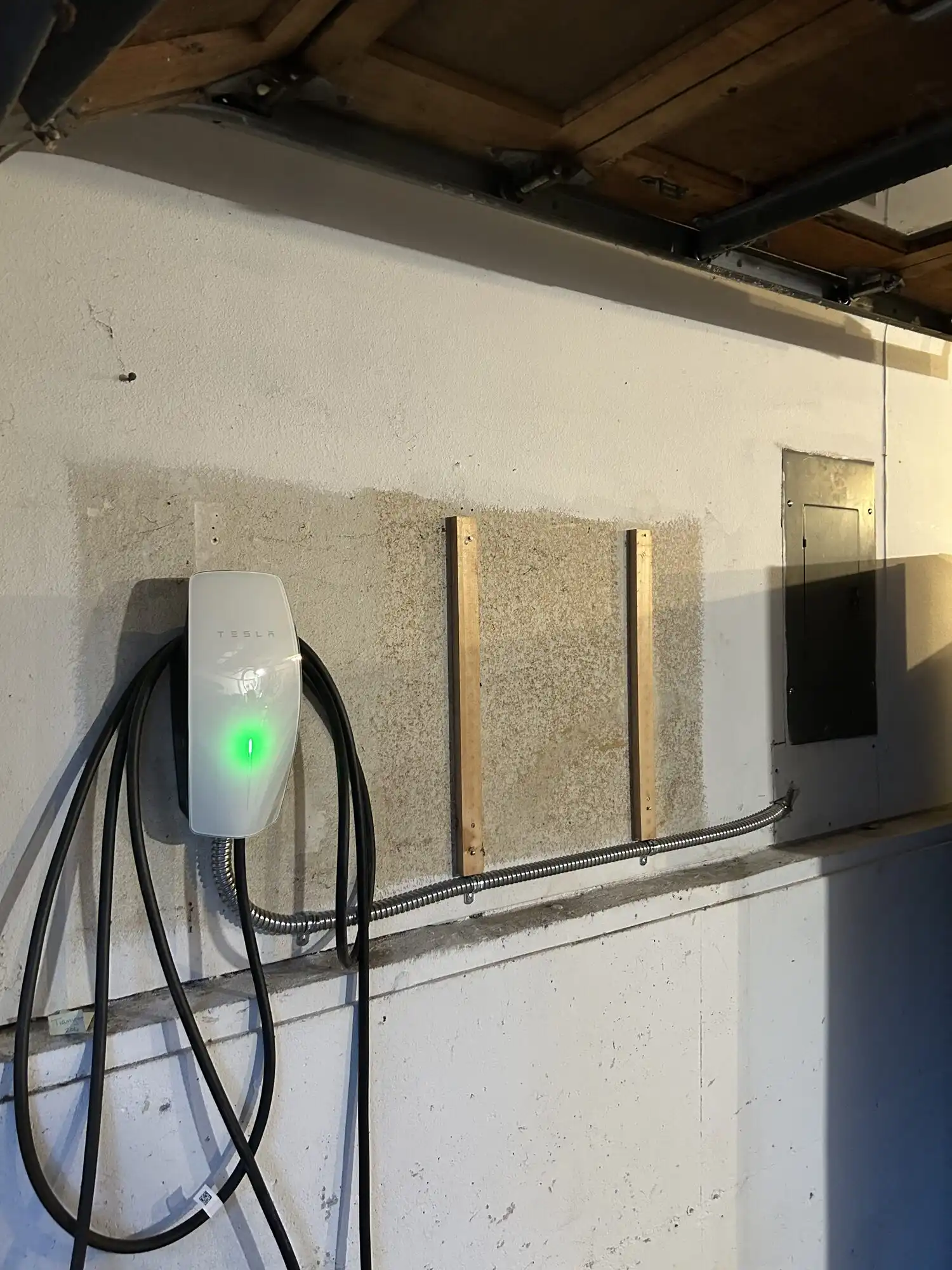
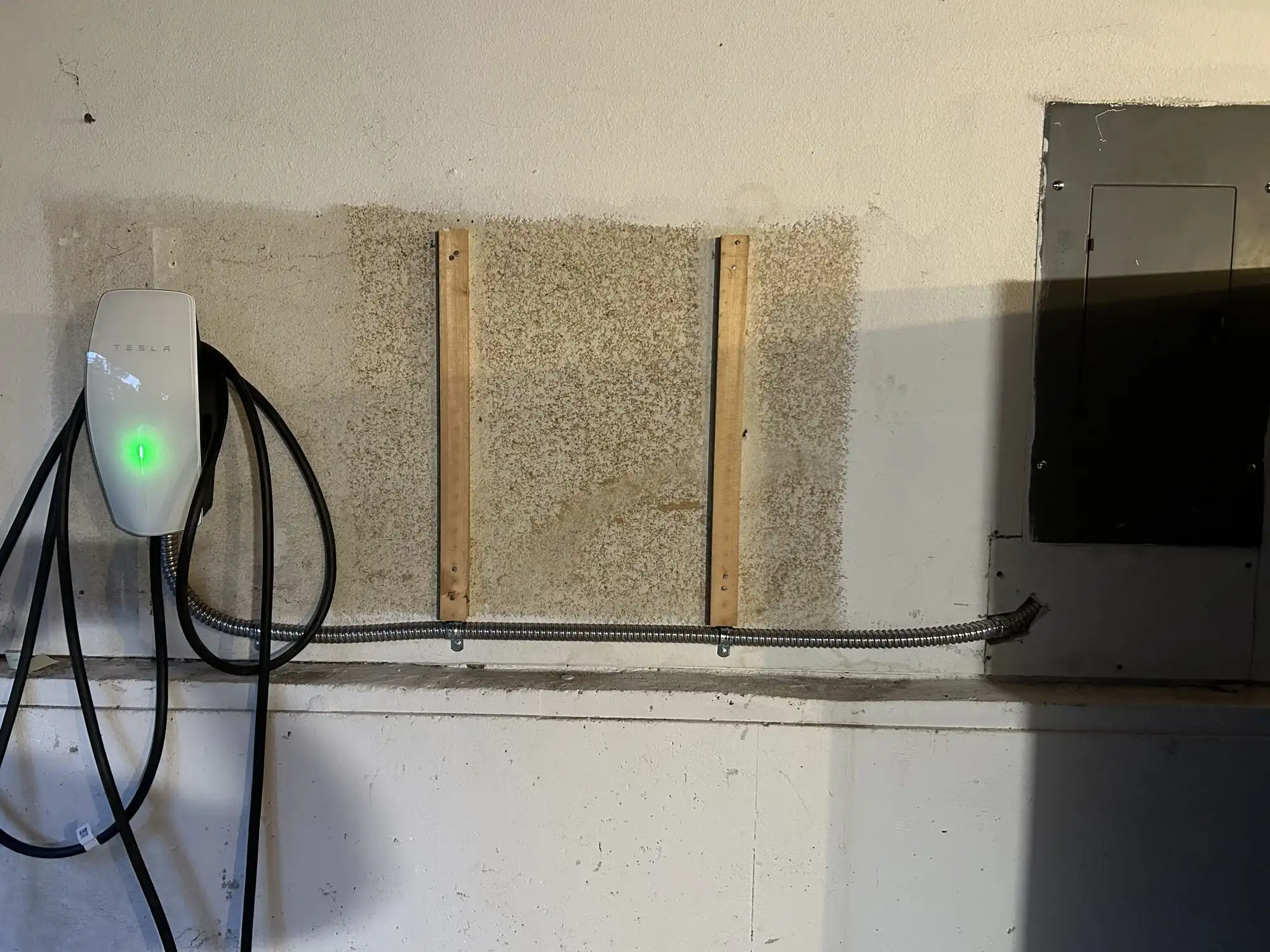
- Federal Way, September 2026. Tesla Wall Connector, hardwired with flexible metal conduit back to the garage subpanel.
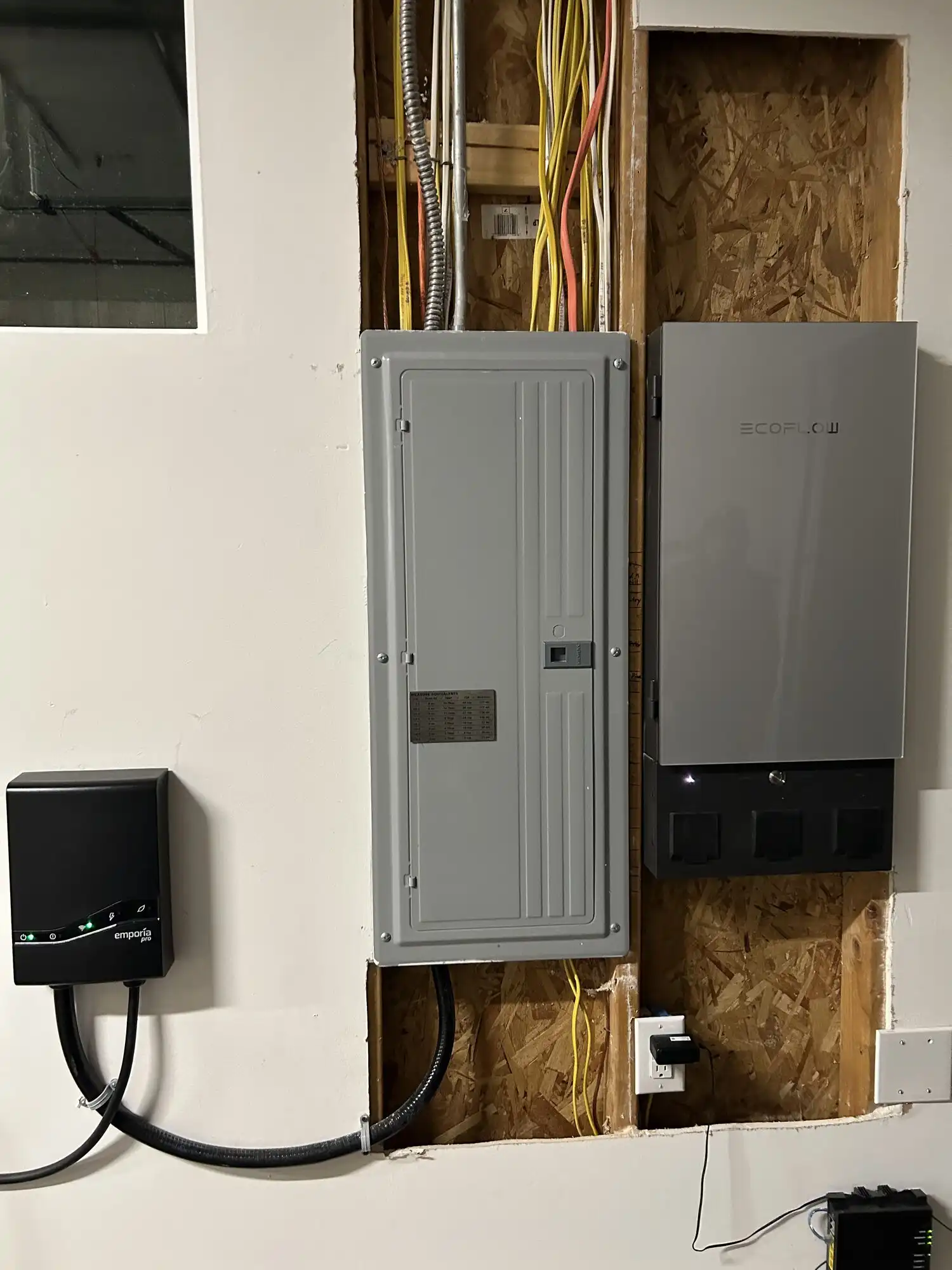
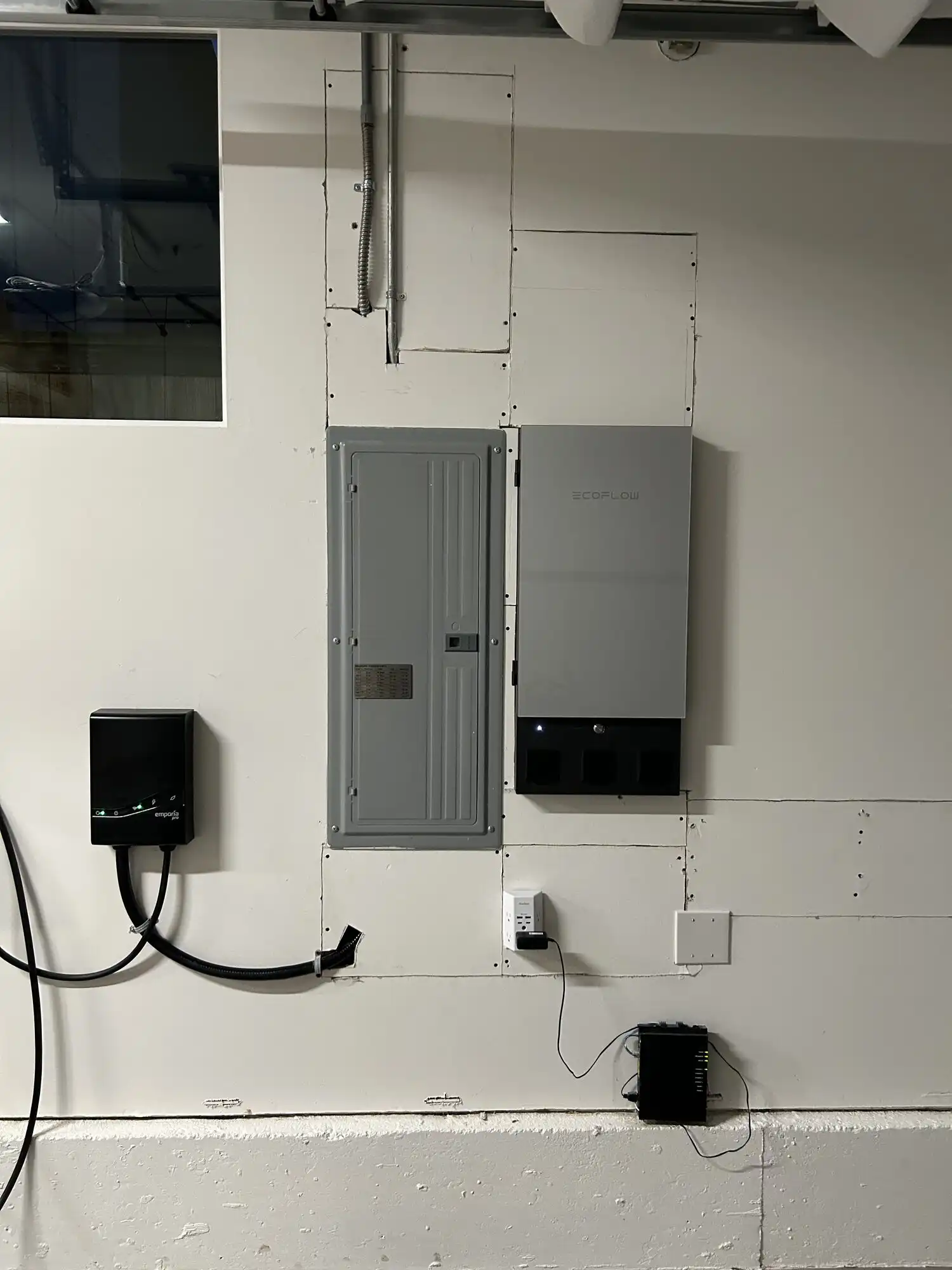
- Seattle, December 2025. Emporia Pro charger installed alongside an EcoFlow Smart Home Panel 2 and a 50 A generator inlet with interlock, over a new 100 A subpanel, permitted through SDCI.
One honest gap: every EV charger we have photographed so far is residential. We have not yet photographed a workplace or multifamily port array, and the commercial galleries elsewhere on this site are tenant-improvement wiring, not charging.
What it costs
| Work | Typical range | What moves the price |
|---|---|---|
| Level 2 EV charger, residential | $900–$2,500 about $1,600 for a straightforward install on a panel with spare capacity | Distance from the panel to the parking spot, whether the run is surface conduit or fished through finished walls, hardwired versus NEMA 14-50, and whether the panel needs a load-management device. |
| Level 2 EV charger with a long or difficult run | $1,800–$4,500 | Detached garages, trenching, 60–100 ft runs, or a subpanel added to feed the charger. |
| Commercial or multifamily EV charging, 2–6 ports | $5,000–$25,000 | Port count, networked versus non-networked hardware, distance from the service, trenching and bollards, and whether the service has capacity. Utility incentives often cover most of it — see /rebates/. |
Prices shown are typical ranges for the Puget Sound area as of September 2026, compiled from published industry and local contractor sources. Every job is quoted after a site visit or plan review. Permit fees, utility charges and equipment are itemized separately unless stated.
What the utility pays
Which utility serves the building decides what you can claim — not which city it is in. See every programme and its source.
| Utility | Programme | What it pays | Who qualifies |
|---|---|---|---|
| SCL | Business EV charging — Tier 2 Apply before you buy the equipment. | 100% of cost up to $50,000 per site (Level 2); up to $200,000 for DC fast charging | Small businesses, WMBE-certified firms, tribal organizations and customers in overburdened communities Verified 5 September 2026 · source ↗ |
| PSE | Multifamily EV charging Apply before you buy the equipment. | Customer-owned 50% up to $2,000 per port; Empower Mobility 100% up to $4,000 per port; PSE-owned turnkey up to $10,000 per port | Multifamily properties in PSE electric territory; ten-year operation commitment Verified 5 September 2026 · source ↗ |
| PSE | Workplace EV charging Apply before you buy the equipment. | Customer-owned 50% up to $2,000 per port; PSE-owned up to $12,000 per port for up to ten ports | Employers in PSE electric territory Verified 5 September 2026 · source ↗ |
| SnoPUD | Commercial and multifamily charger rebate Apply before you buy the equipment. | $1,000 per port at existing sites; $500 per port in new construction; maximum ten ports | Commercial and multifamily sites in SnoPUD territory; chargers from the qualified product list; claim within 90 days Verified 5 September 2026 · source ↗ |
| Tacoma Power | Community EV charging Apply before you buy the equipment. | $5,000 per networked port (up to $50,000); $10,000 per port in priority zones (up to $70,000); $2,000 per non-networked port | Commercial and multifamily sites in Tacoma Power territory. Workplace-only sites are excluded from the priority tier. Status: Funding was temporarily paused in 2026; applications were still being accepted as of 2026-09-05. Confirm before relying on it. Verified 5 September 2026 · source ↗ |
Utility incentives are set by Seattle City Light, Puget Sound Energy, Snohomish County PUD and Tacoma Power and change without notice. Figures were last verified on 5 September 2026. Most programs require pre-approval before equipment is purchased; HB Power Electric helps prepare applications but cannot guarantee approval or amounts.
Code and compliance that shapes the scope
- Washington State Building Code Table 429.2 — EV-ready parking
- New commercial buildings in Groups A, B, E, F, H, I, M and S must provide 10% EVSE-installed, 10% EV-ready and 10% EV-capable parking spaces; Group R multifamily must provide 10% EVSE-installed, 25% EV-ready and 10% EV-capable. Sites with fewer than ten spaces are generally exempt except in Groups A, E and M. Confidence: medium — confirm the adopted percentages with your jurisdiction before bidding · Verified 5 September 2026 · source ↗
- RCW 64.90.530 — right to charge
- Since 2026-01-01, condominium and HOA governing documents in Washington may not prohibit a unit owner from installing an EV charging station, subject to reasonable conditions. Verified 5 September 2026 · source ↗
Work we have photographed
Common questions
Do I need a permit to install an EV charger in Washington?
Yes. An EV charger is a new branch circuit, and WAC 296-46B-901 requires the electrical permit to be bought before the work starts. The obligation sits with the licensed contractor, not with you. Who issues it depends on the address: SDCI in Seattle, the city in Bellevue, Everett, Federal Way, Kirkland, Redmond, Sammamish, Lynnwood and Renton, Tacoma Power in Tacoma, and Washington L&I in Bothell, Kenmore, Issaquah, Kent, Edmonds, Covington, Auburn and Puyallup. HB Power Electric pulls the permit, meets the inspector and hands over the signed record at closeout.
Can my 100 A panel handle a Level 2 charger?
Often yes, but not always at full output. We run a load calculation under NEC 220.83 against the existing service before quoting. A 100 A service already carrying an electric range, a dryer and a heat pump frequently fails that calculation at 48 A. Two fixes usually work without touching the service: set the charger's maximum current down to 32 A or 24 A at commissioning, or add a load-management device under NEC 750 that sheds the charger when the house approaches the service limit. A service upgrade is the last resort, not the first.
Should I hardwire the charger or install a NEMA 14-50 outlet?
Hardwiring gets you the full 48 A on a 60 A circuit, and it is the only option above 50 A, because a NEMA 14-50 is a 50 A receptacle. A NEMA 14-50 receptacle sits on a 50 A breaker and limits the car to 40 A continuous, but it costs less and lets you unplug the unit and take it with you. The trade-off is that a receptacle feeding a charger needs GFCI protection under NEC 625.54, and GFCI breakers cost more and nuisance-trip with some vehicles. For overnight charging in a garage, 9.6 kW versus 11.5 kW rarely matters.
How much does EV charger installation cost in Seattle?
The price table on this page carries the current ranges and the date they were checked. What moves a job inside that range is the distance from the panel to the parking spot, whether the run is surface conduit or fished through finished walls, hardwired versus a NEMA 14-50 receptacle, and whether the panel needs a load-management device or a spare slot created. Detached garages and trenching are the two things that reliably push a job into the higher band. Every job is quoted after a site visit.
Can my condo or HOA stop me from installing an EV charger?
Not outright. Since January 1, 2026, RCW 64.90.530 has barred Washington condominium and HOA governing documents from prohibiting a unit owner from installing an EV charging station, subject to reasonable conditions. An association can still require a licensed contractor, a written scope, and restoration of any common-area finish that is opened up. The practical questions in a shared garage are electrical: whether the power comes from your unit panel or the house meter, how the energy gets billed back, and whether the house service has capacity for more than one space.
Are there rebates for a home EV charger in Puget Sound?
Not right now. None of the four utilities on this corridor offers a residential charger rebate as of 2026-09-05, so budget a home install at full cost. Every incentive shown on this page is for a commercial, workplace or multifamily site, and every one of those programs requires pre-approval: apply and get written approval before any hardware is bought, or the money is gone. The rebates page carries the current figures and the date each was checked.
Send a photo of your panel
A photo of the open panel and the paper directory, plus roughly how far the parking spot is from it, is usually enough to price a home charger. For a workplace or multifamily lot, send a site plan and the meter number.
We reply as soon as we are off the job — usually the same day.