Everett · July 2026
Level 2 EV charger on a NEMA 14-50 in an Everett garage
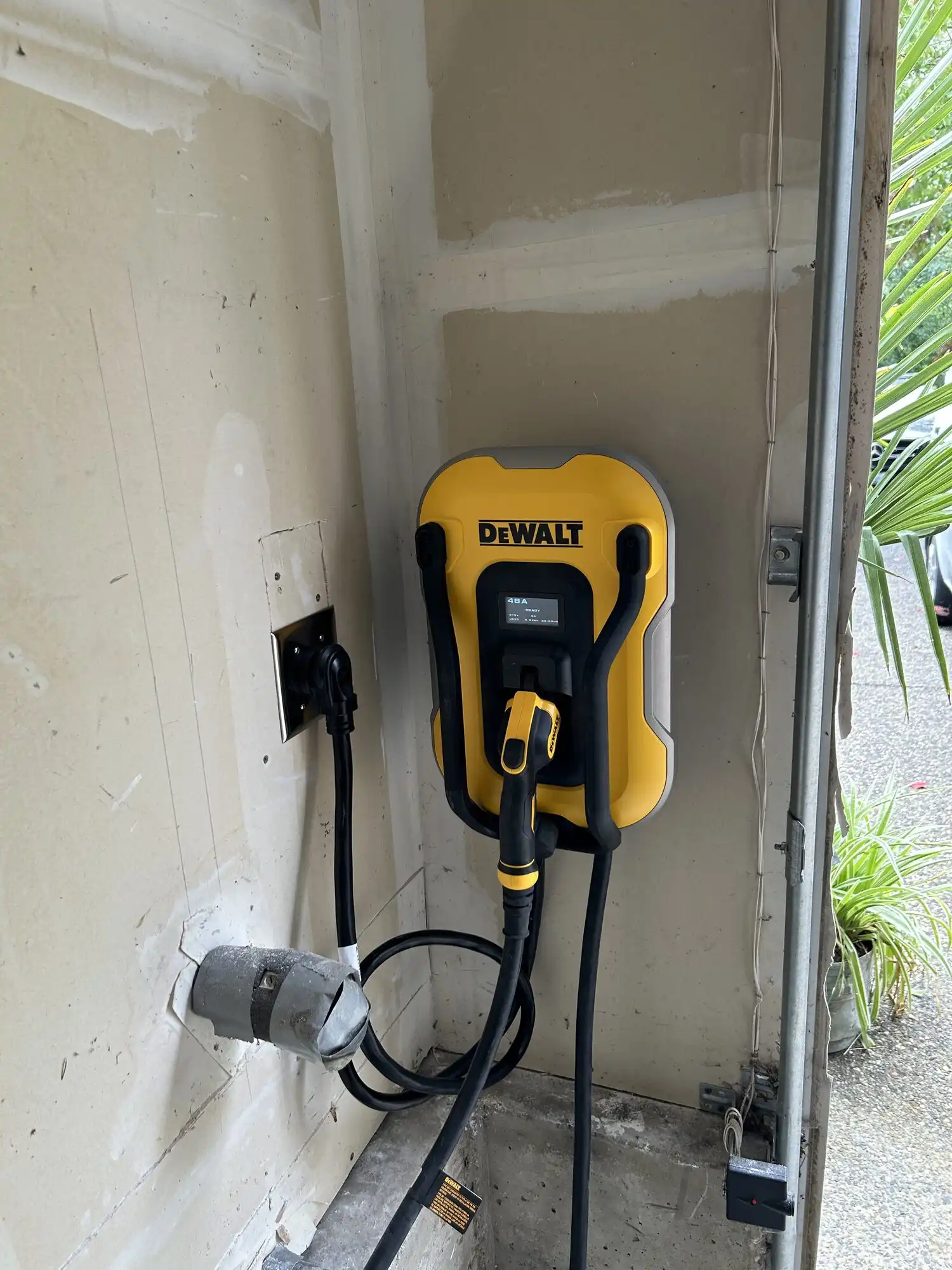
In July 2026 an Everett homeowner wanted a Level 2 charger in an attached garage. A load calculation showed the existing 200 A panel had room, so the work was one new Eaton two-pole breaker, a short run to the garage door wall, and a NEMA 14-50 receptacle for a DeWalt 48 A charger. The permit came from the City of Everett, not L&I.
| City | Everett, Snohomish County |
|---|---|
| When | July 2026 |
| Property | Single-family home, attached garage |
| Scope | Load calculation on an existing 200 A service, a new Eaton two-pole breaker labelled Car Charger, a short run to the garage door wall, and a NEMA 14-50 receptacle for a DeWalt 48 A Level 2 charger. |
| Permitting authority | City of Everett |
| Equipment | DeWalt 48 A Level 2 EV charger · NEMA 14-50 receptacle · Eaton two-pole breaker · Existing 200 A load center |
| Permit note | Permitted through the City of Everett, which issues and inspects its own electrical permits rather than L&I. The permit number and the address are not published here. |
What the homeowner needed
A Level 2 charger on the garage door wall, close enough that the cable reaches the car without crossing the floor, and a unit that could come off the wall later. Nothing else: no second charger, no battery, and no panel work if it could be avoided.
Why this job needed no panel work
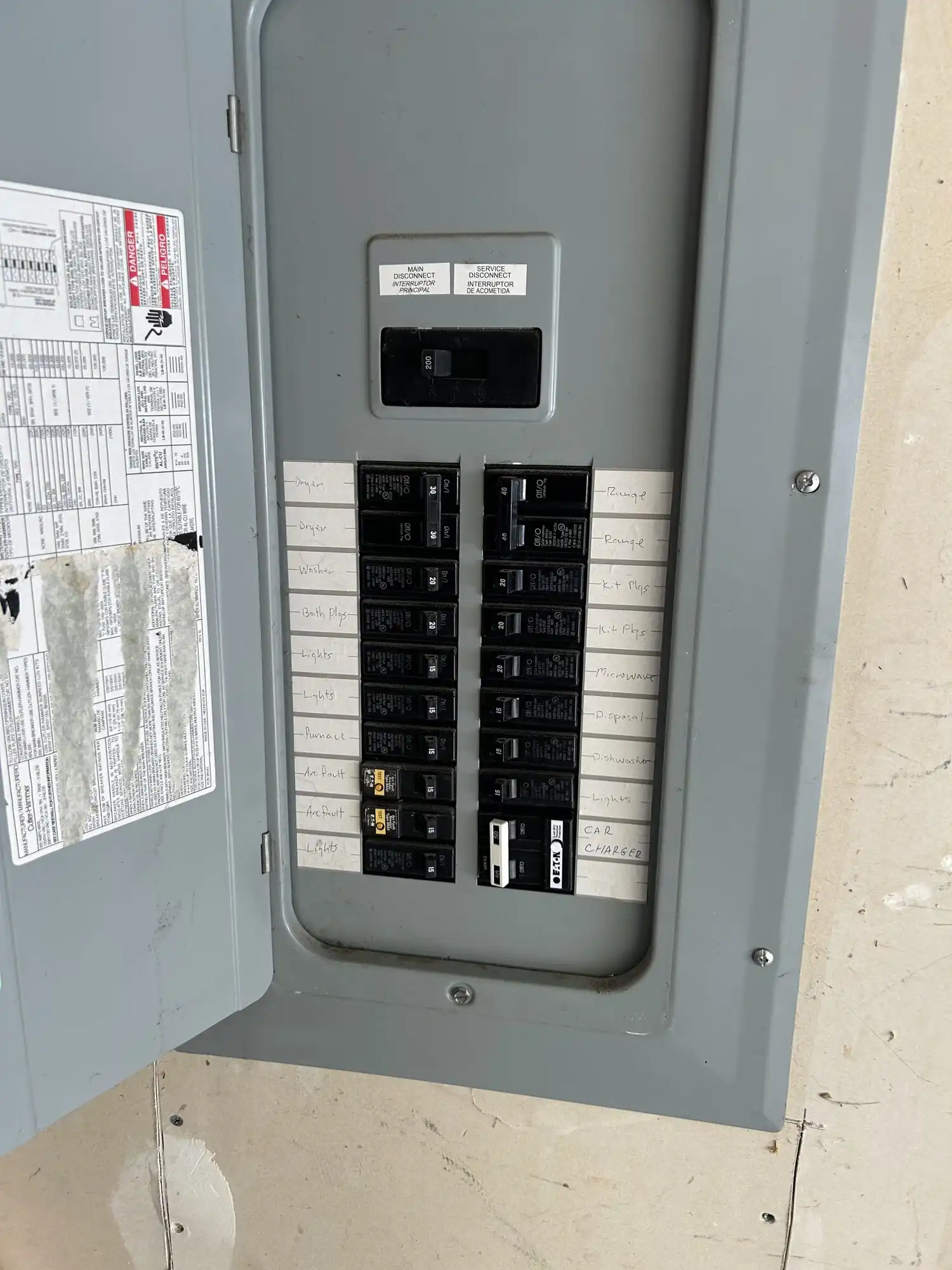
The load calculation came first. Under NEC 220.83 the existing 200 A service was already carrying a range, a dryer, a furnace, kitchen circuits and a pair of arc-fault-protected circuits, and it still had headroom for a 50 A charger circuit. The load center also had a free double-pole position, so no subpanel was needed.
A new Eaton two-pole breaker then landed in the bottom right of the panel and went onto the paper directory as “Car Charger”. The receptacle went up a few feet away, with the DeWalt unit mounted above it.
When it is not this simple
Three things change the shape of the work:
- A 100 A service. The 220.83 calculation often fails at 48 A once a house has an electric range, a dryer and a heat pump. Setting the charger’s maximum current down to 32 A or 24 A at commissioning usually clears it, and a load-management device under NEC 750 is the next step. A 100 A to 200 A service upgrade at $8,000–$16,000 is the last resort, not the first move.
- A panel with no free slots. Capacity on paper is not space in the enclosure. A subpanel at $1,500–$3,500 comes before the charger circuit exists.
- A detached garage. A trench and a feeder push the job into the $1,800–$4,500 band.
Those are published Puget Sound market ranges as of September 2026, not quotes.
No rebate on this job
Everett is Snohomish County PUD territory, and no utility on this corridor pays a rebate on a home charger. SnoPUD’s charger rebate is written for commercial and multifamily sites, not for a single-family garage. Everett also sets its own electrical permit fees, so the L&I fee schedule does not apply inside the city.
We photographed the finished charger and the panel only: there is no shot of the receptacle before the cover plate went on, and no permit record is published for a residential job.
Photographs from this job
Common questions
Who issues the electrical permit for an EV charger in Everett?
The City of Everett. Everett is one of the Washington cities that issues and inspects its own electrical permits, so a charger circuit inside city limits is not an L&I permit and is not an SDCI permit either. Under WAC 296-46B-901 the licensed electrical contractor buys that permit before the work starts, which is the contractor's obligation and not the homeowner's. HB Power Electric pulls it, meets the inspector and hands over the signed record at closeout.
How do you know a 200 A panel can take a Level 2 charger?
By running the load calculation before quoting, not after. NEC 220.83 adds the existing general lighting, small-appliance, range, dryer and heating loads to the proposed 50 A charger circuit and compares the total against the service. On this house the 200 A service still had headroom, and the load center had a free double-pole position. Both have to be true. A panel with spare amperage but no free slots still needs a tandem-rated arrangement or a subpanel before the charger circuit exists.
Why a NEMA 14-50 receptacle instead of hardwiring the charger?
The homeowner wanted the unit removable. A 14-50 sits on a 50 A breaker, so the car draws 40 A continuous, 9.6 kW at 240 V, against the 11.5 kW the same DeWalt unit does hardwired on a 60 A circuit. Overnight that difference rarely matters. The catch is NEC 625.54: a receptacle feeding an EV charger needs GFCI protection, and a GFCI breaker costs more than a standard one and nuisance-trips with some vehicles. Hardwiring avoids that entirely.
What does the inspector look at on an EV charger circuit?
The breaker size against the conductor size, the receptacle type and its GFCI protection, the equipment grounding conductor and bonding, how the cable or conduit is supported through the garage, the working clearance in front of the panel, and the circuit directory. A charger circuit is a small scope, so the inspection is short, but a mislabeled directory or an unsupported run will still fail it and cost a second visit.
Shown with the customer’s permission. All location metadata has been removed from these files and no street address, unit number or identifiable person appears in them.
Have a job like this?
Call or text and you will reach the owner, not a call centre. For anything with a drawing, an equipment list or a deadline, send it through the quote form and you will get a written scope back.
We reply as soon as we are off the job — usually the same day.